
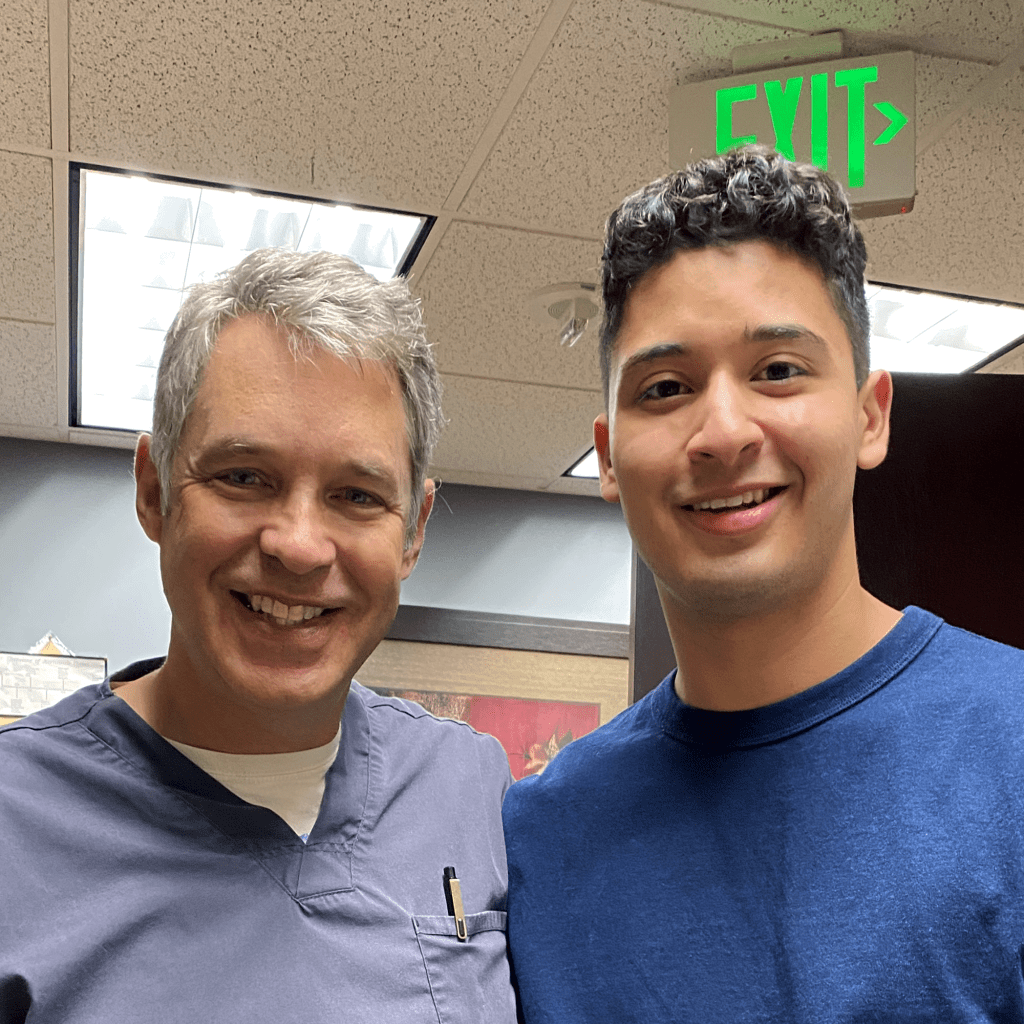
Markus with Dr. Kronson
I met Dr. Jeffrey Kronson through his wife, Dr. Jean Chou. Following my interview with her, she connected me with him. I prepared a set of carefully considered questions, and set up a date to meet him. What followed was not only an astonishingly insightful conversation with the USC resident and Stanford fellow. As an aspiring neurosurgeon, I left my conversation with a vascular surgeon feeling more assured than ever that I was chasing the right career.
I began by focusing on his specialty. Most pre-surgical students I know aren’t chasing careers as vascular surgeons. Curious, I asked how he decided to travel down such a niche avenue. As a high schooler, feeling discouraged about a computer science career, Dr. Kronson found solace in the portability of a medical career. As a Canadian-accredited doctor who sought to build his life in the US, he could bring his MD across the border. At first, he tried his luck with psychiatry and internal medicine, but found them to be too hands-off. Later in our talk, he divulged that “[During my internal medicine rotation,] we’d start in the morning in the conference room—talk about the patients; we’d walk around for two hours—talk about the patients; do a couple of adjustments; and then we’d go do the scut work that you had to do during the day…then you’d meet at five o’clock in the conference room—talk about the patients; and then you’d walk around for two hours, and talk about the patients again. Nothing. Ever. Changed.” During his surgical rotation, he fell in love with immediately making a difference in a patient’s life. But, it wasn’t until working with a pair of vascular surgeons that, within an hour of watching them, he found his calling.
With how hidden these kinds of specialties can be, the passions of innumerable pre-surgical students can be left shamefully undiscovered until residency rotations force them into all sorts of different specialties. To garner exposure as undergraduates and med school students, Dr. Kronson recommends researching all kinds of specialties and then shadowing surgeons working in them. He notes that now is an especially opportune time to explore this route, since many surgeons are shifting their practice into personal clinics. Surgery has weaned itself off hospitals and their resources, facilitating the observation of procedures for students. Dr. Kronson’s proposed path is as follows: “Shadow a general surgeon,”—so as to learn bedside manner and patient care—“and then shadow somebody in the specialty you’re interested in.” Not only are these experiences great demonstrators of character for med school applications, they also provide exposure to surgery itself. Dr. Kronson shared a story of an intern who was certain of his future in surgery, but fainted upon seeing blood for the first time. Unfortunately for the student, this is a reflex that he would likely not be able to control. The student, and those like him, would simply struggle too much cutting patients open to effectively pursue the career. He would have known this earlier, and saved himself much time, had he discovered it through shadowing.
My next question hinged on a surgeon’s post-residency training—the fellowship. My understanding of a fellowship was that it tends to be a stepping stone into sub-specialization. But, I wondered if a fellowship can be used as a supplementary “mini-residency,” per se. As he told me, however, this isn’t common. Logistically, it doesn’t make sense for a hospital to give a fellowship to a surgeon who won’t continue on that track. Fellowships also extend over long stretches of time—usually a few years—, and additional ones can be impractical to take following already long residencies and eight years of formal schooling. Besides, through a fellowship, a surgeon will gain experience in all areas pertinent to their sub-specialty, further decreasing the utility of additional ones.
After this, our conversation transitioned to a topic I had also discussed with Dr. Chou. Due to the degree of strain surgical training induces, success in the field pivots on a surgeon being truly driven by passion. Residencies are physically and mentally draining, and surgical ones are even more so. His schooling and training lasted a total of 16 years, whereas it only takes around 11 years for non-surgical doctors. Further, whereas a non-surgeon can stay overnight in a hospital every four days, surgeons most commonly receive bidaily overnight shifts. These shifts are seemingly interminable, too. Over the course of a week, Dr. Kronson would work 120 hours. It was only until his final year of residency that he was allowed to work eighty or ninety hours per week. To contextualize these, most nine-to-five employees only work forty hours in any given week. Upon arriving home from his lengthy shifts, it was common for him to consider if he was too hungry to sleep, or too weary to eat; most often, the tiredness won out. After his first day in the ICU, Dr. Kronson even admitted his doubts to his chief resident. A coldly succinct response has stuck with him since, though—“If you want to quit, quit.” It shifted the matter from whether he could handle the burden of residency, to whether he would even feel fulfilled working another career. He couldn’t see himself doing anything else. So, even as the training became exponentially harder, his adoration of the field held him steadfast.

With neuroscience as a particular interest of mine, I was also intrigued by Dr. Kronson’s first publication. It was a study focusing on the rate at which chemically dependent patients—those addicted to substances—suffer from dissociation. He explained that dissociation can take many forms, depending on the severity. In essence, dissociation is the separation of consciousness from reality. Multiple personality disorder sits at one extreme. At the other lies a drive during which one forgets the journey entirely, but arrives at their destination safely and correctly. I wondered how he involved himself with the study. He explained that, in many cases, it can be a matter of meeting someone at the right time. It certainly was for him. Following the study, Dr. Kronson’s work led him to inpatient psychiatric care. It was here that he didn’t find what he was looking for, and broke off into medicine.
A tangential discussion ensued, centering around how these types of experience initiatives can open many kinds of doors. He cited the example of a friend’s daughter. Despite not having high school grades matching the caliber of her peers, she stood out among them for a very specific reason. After discovering a Stanford professor who produced documentaries in wartorn areas, she made her own and submitted it with her application, alongside an expression of wanting to work with that professor. In tandem with that collaborative desire, it was impressive enough that Stanford admitted her. He said, “When you’re transferring and applying to these name institutions, you need to provide them with something that differentiates you from everyone else that’s applying. So it’s the same thing with my buddy and I…[The psychiatry study] was interesting work to put in our resumes when we applied to medical residencies.” Research also provides networking opportunities, which are taken advantage of in a unique manner in this field. Medicine contrasts with law and business, in that, at the dawn of a doctor’s career, their connections vouch for their abilities and character more than they explicitly provide jobs, clients, or even capital. Medical programs look for doctors that, before anything else, can properly take care of a patient. Barring academic positions, a doctor’s education means nothing so long as they are reliable healers. Letters of recommendation are crucial votes of confidence towards that. This holds especially true for surgery, where the magnitude of a mistake’s consequences are perhaps the greatest. Surgical programs give positions only to the best, and often formulate their decisions while relying on what experienced MDs share about a young doctor. Through research, a student collaborates with experts to whom they can demonstrate their abilities. Outstanding bedside manner, knowledge, technical expertise, logistic aptitude, and analytical skills can all be put on display for a superior to take notice of. If the student then establishes a mentor relationship with them, they can obtain a vivid testimony of their prowess to attach to applications. Dr. Kronson noted that as a student progresses, the competition only becomes tougher to fight through, raising the value of such letters. “If you have somebody whose letter says—and I’ve seen this once in my life—‘this is the best student I have ever worked with. This student would be a credit to any program he or she was matched in. I can’t wait til this student finishes their training, because I want to bring this student into my practice as a colleague,’ they’ll get in anywhere. And that comes from doing fantastic work for a person.” As a student funnels through their career, the focus of this kind of work must narrow, too. Dr. Kronson remarked that, “Having experience in different things like that helps you get your foot in the door. The closer it is to your chosen field or specialty, it can be a bigger foot.” After high school, a student must demonstrate they are fit for pre-med; after undergraduate school, that they are prepared to undertake medicine professionally; after medical school, that they are qualified to continue into their specialty; after residency, that their fellowship will further chisel out an astounding David of a specialist.
We diverged from the topic as we discussed Dr. Kronson’s experiences working in a hospital and his own clinic. Many differences separate the work at each location, but the most noticeable one lies in the acuity of the patients at each. Dr. Kronson’s hospital patients are generally sicker, requiring much more equipment and care than his clinic patients. This isn’t to say that the clinic hinders his work, though. There, he keeps all the tools he needs with him, and can perform most of his surgical procedures. But more intricate surgeries necessitate that he work from a hospital OR. That brings with it a compromise, however. In his clinic, Dr. Kronson works for himself; at the hospital, he is someone’s subordinate. This lack of independence has led him to prefer working out of his clinic. A constant at each place, though, is the depth of patient-doctor interaction. Whether face-to-face in the clinic, following up on outpatients, or watching over inpatients, Dr. Kronson constantly has to care for his patients. It lies in the nature of his work. “Vascular surgery is plumbing,” he described, “and you have to follow a patient forever, and ever, and ever.” Working from his own clinic also allows him to increase the amount of procedures he does. He’s found that the number has doubled, going from around 650 cases in a busy year to 1200 or 1300. This may seem daunting, but it’s not for a man who loves his job.
We then took a short break. Upon resuming I asked about his toughest day in the OR. During his time in residency, cardiothoracic and vascular surgeons subjected their students to, as he put it, abused child syndrome—a cycle of exploitation by superiors unto residents, who, many years later, wear their own residents thin. These residencies have become widely accepted as some of the most grueling ones. The surgeons-in-training, pushed over the brink of exhaustion, commonly fall asleep mid-procedure. It’s not rare to see a resident knocked out on their feet as they hold a retractor. Dr. Kronson dozed off in a more unfortunate position, however. Following 52 hours of being awake, he almost fell asleep into a wound while holding a needle. Thankfully, it didn’t have major repercussions and the vascular surgeon working with him was understanding. But, it was embarrassing and spoke to how onerous that particular shift had been. He continued on to a description of his most horrifying experience in the OR. It involved a cancer patient whose vena cava ruptured. Unlike arteries, vein walls are terribly thin and inelastic, making them stubbornly difficult to repair. Dr. Kronson compared these efforts to “trying to sow a hole in a lake.” While working on the patient, the vein suddenly burst open. Adrenalyn flowed through his bloodstream as he realized what had happened to the man on his table. A tremble made its way up his wrist, through his metacarpals, and agonizingly reached his fingertips. Consumed by the fear, he stepped back and drew in a few quivering breaths. A realization suddenly overpowered what had until now been an all-consuming panic—if he did not act quickly and precisely, his patient would die, not from the cancer, but from this rupture. Resolve ushered itself in as he let his training guide him. He worked diligently through the shock that had petrified him, and managed to repair the hole. As he finished the operation, the anxiety subsided. He had saved the man’s life.
Strangely, this led us to discuss the scholarly nature of surgery. The most informative part revolved around the schools a doctor attends—they don’t matter outside of academic surgery positions. An academic surgeon is one who engages in research and teaches others, contributing to advancement and innovation more so than directly healing patients. Most surgeons do not pursue these positions; they dedicate themselves to primarily serving as physicians. With so many excellent medical schools and residency programs throughout the country, the latter type of doctor is ensured a proper education almost anywhere. Barring programs of outright poor quality, these programs practically guarantee their competence and ability, given their own desire to learn permits that success. A doctor for whom Dr. Kronson once interviewed put it like this: “I see you’ve got all these degrees, you went to Stanford…good for you. Who cares? All I care about is whether you can take care of patients.” Only within academic centers, among research-focused surgeons, is it important to have attended schools like Harvard, or to have done a residency at places like Massachusetts General Hospital. Otherwise, a surgeon’s abilities and their performance far supersede these credentials. Instead of considering what school to attend, Dr. Kronson thinks that it is more important that a future surgeon figure out exactly what they want to do with their life. The training is arduous, and the ends must justify the means. His recommendation was to research what a career in a given specialty looks like. Surgeons are limited to the organ system of their specialty, and constantly work with the same diseases and procedures. It is imperative that the way in which a surgeon dedicates his life to medicine is a manifestation of their own desires. They should be happy with the common duties of their job. It isn’t anywhere near as helpful to pursue famous schools. With himself as an example, Dr. Kronson reflected, “If I had known then, I would not have shot for these big institutions…I did not get into UCLA, I did not get into Harvard Medical Center in Washington State, I did not get into UCSF…I got into [choice] number five, and I would not have been any better of a surgeon if I had gotten into those other places.” So much learning happens in the field—regardless of where a surgeon is—, and not in the classroom. Whether in residency or med school, prestige carries no tangible benefit for most surgeons.
Our conversation wound down as we discussed a number of smaller topics. Among them was the utter importance of maintaining humanity. A doctor is a healer before they are anything else. Primum non nocere (“first, do no harm” in Latin) governs medicine through an absolute monarchy. It is a principle any doctor in any specialty abides by. Honesty—to superiors, patients, and peers—, admitting mistakes, and empathy are attributes that any physician should demonstrate. Otherwise, they simply cannot carry out their duties, and would violate the very tenets the Hippocratic Oath holds them to.
This drew us to the end of our discussion. We concluded the interview with my mind a blossomed field of newfound knowledge and insight, ripe for a prime harvest. Before I left, though, I made sure to express my respect for the collection of Porsche 911 calendars he had on his walls. It felt good to know that surgeons could still have time to enjoy German engineering’s finest project.
 MedConnect